
Click to view the full report
A Two-Speed Market: Industrial Tightens as Downtown Office Vacancy Rises
Metro Vancouver’s commercial real estate market moved in different directions during the third quarter of 2026.
Industrial vacancy tightened, retail remained resilient, and apartment asking rents showed early signs of stabilization. Downtown office, meanwhile, recorded its highest vacancy rate in more than two decades as major technology tenants consolidated their space.
For buyers, sellers, and occupiers, the message is clear: market conditions depend increasingly on the asset class, location, and income behind each property.
Here is our take on the region’s four core commercial asset classes and what we are watching heading into year-end.
Office: Downtown Vacancy Rises as Technology Tenants Consolidate
Metro Vancouver’s office market softened in Q3, moving against the broader national recovery.
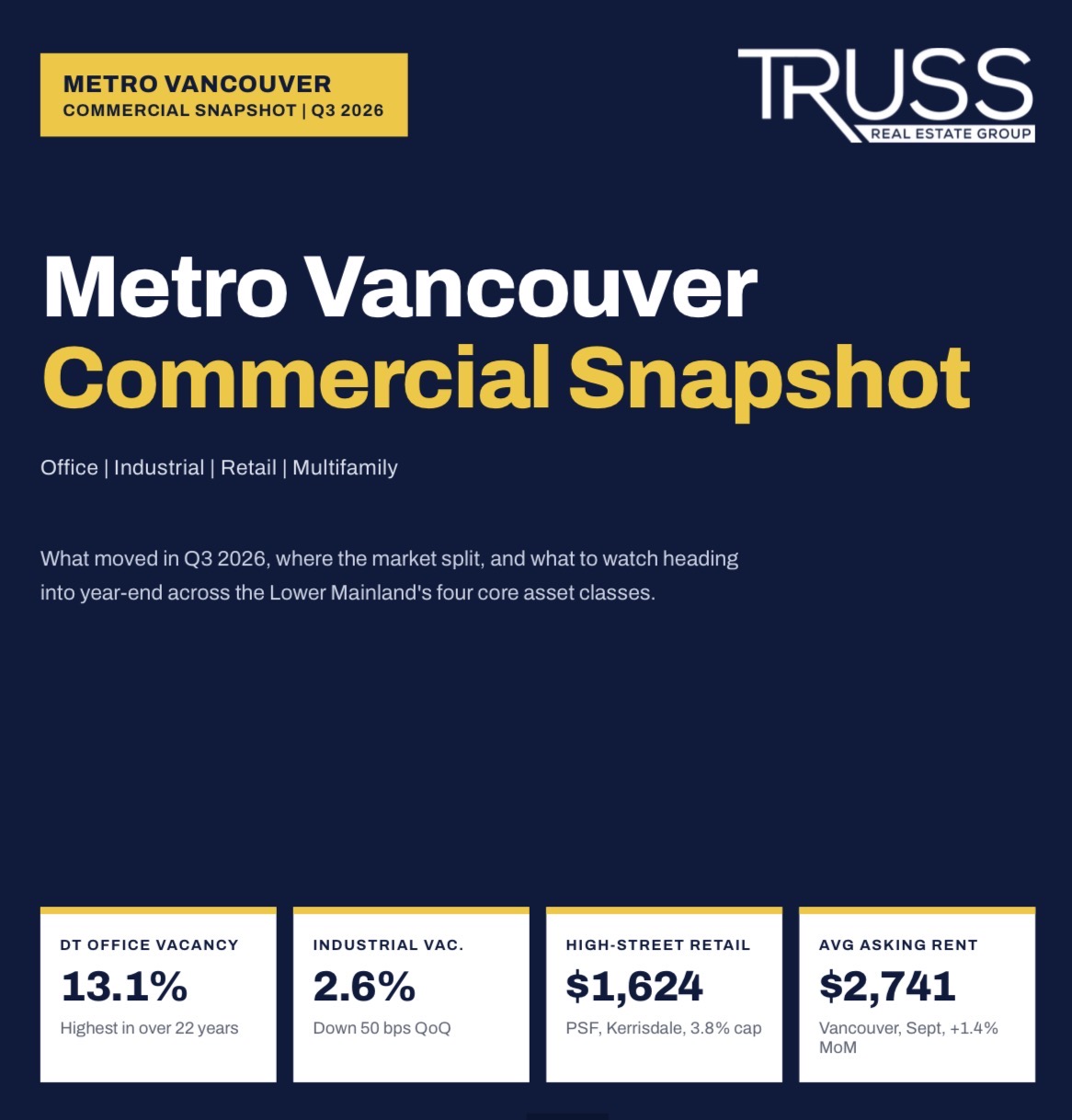
According to CBRE, downtown Vancouver vacancy rose to 13.1%, up from 12.2% in Q2 and the highest level in more than 22 years. Across Metro Vancouver, office vacancy increased to 12.2%, while suburban vacancy edged up only slightly.
Much of the downtown increase reflected two large blocks of space becoming vacant as technology tenants consolidated their operations. The shift was concentrated rather than evidence of a uniform decline across the entire office market.
For tenants, elevated vacancy creates opportunities to negotiate lease terms and assess relocation options. For owners, securing tenants will require competitive pricing and a clear understanding of how their buildings compare with available alternatives.
With no significant new office supply expected before 2030, the longer-term outlook will depend largely on how quickly existing vacant space is absorbed.
Industrial: Vacancy Tightens, but Pricing Has Yet to Follow
Industrial conditions improved through Q3, although asking rents and sale prices continued to adjust.
Colliers reported industrial vacancy falling to 2.6% and availability declining to 3.7%, bringing both measures below 3% and 4%, respectively, for the first time in 10 quarters. CBRE separately recorded approximately 1.1 million square feet of net absorption, with leasing activity concentrated in units under 30,000 square feet.
Despite tighter conditions, CBRE reported Vancouver industrial net asking rents down 5.0% year-over-year and average asking sale prices down 13.3%.
For occupiers and owner-users, this creates a market worth watching closely: space is becoming less available while pricing remains below previous levels.
The key question heading into Q4 is when improving occupancy begins to translate into more stable rents and asking prices.
Retail: Prime Locations Continue to Attract Capital
Retail remained a resilient part of Metro Vancouver’s commercial market.
First-half investment data from Altus showed Vancouver retail transaction volume reaching approximately $866 million, up 1% year-over-year. It was the only major commercial asset class to record growth over that period, supported by demand for grocery-anchored centres and prime street-front properties.
Oakridge Park also provided a significant signal of consumer demand, attracting close to 1.5 million visitors in its opening month, according to QuadReal.
As the development establishes itself, attention is turning to how luxury retailers balance their Oakridge locations with existing stores along Alberni Street.
Recent street-front transactions also demonstrate continued investor interest in established retail corridors. Location remains a major draw, but buyers still need to assess lease duration, tenant strength, and future leasing exposure alongside the purchase price.
Multifamily: Asking Rents Show Early Signs of Stabilization
Vancouver’s rental market showed some improvement in September, although one month of growth does not establish a sustained recovery.
Rentals.ca and Urbanation reported average asking rents rising 1.4% month-over-month to $2,741, the strongest monthly increase among Canada’s six largest markets. One-bedroom asking rents increased to $2,373, up 1.0% from the previous month.
Investment activity remained subdued. Altus reported first-half Vancouver multifamily transaction volume of approximately $372 million, down 41% year-over-year.
Transactions highlighted in our snapshot show buyers assessing opportunities through current income, location, and underlying land value. For investors, disciplined underwriting remains essential, particularly where a purchase depends on future rent increases to achieve its target return.
The next test is whether September’s improvement holds through the slower winter leasing season.
What We’re Watching
Heading into year-end, several developments could shape the market:
- How quickly the large vacant downtown office blocks attract new tenants.
- Whether tighter industrial vacancy leads to rental stabilization.
- How Oakridge Park influences established retail corridors, particularly Alberni Street.
- Whether Vancouver’s apartment asking rents continue to find a floor.
- How interest-rate decisions and trade-policy uncertainty affect financing and investment confidence.
The Truss Perspective
Q3 reinforced the importance of understanding each opportunity on its own merits.
Downtown office tenants have greater negotiating leverage. Industrial owner-users are seeing lower asking prices alongside tightening availability. Well-located retail continues to attract capital, while multifamily buyers remain focused on income and long-term value.
For sellers, realistic pricing and clear financial information are essential. For buyers, the opportunity lies in identifying where current pricing, property fundamentals, and their own objectives align.
This market rewards preparation, local knowledge, and disciplined decisions.
Work With Truss Real Estate Group
If you are considering buying, selling, leasing, or investing in commercial real estate across Metro Vancouver and the Fraser Valley, our team is here to help you navigate the market with research-informed advice and local expertise.
Connect with us to discuss your commercial real estate goals.
Download the Full Q3 2026 Market Snapshot
Explore the full Metro Vancouver Commercial Real Estate Market Snapshot for Q3 2026.
Truss Real Estate Group | Stonehaus Realty Corp.
Commercial. Development. Investment.