
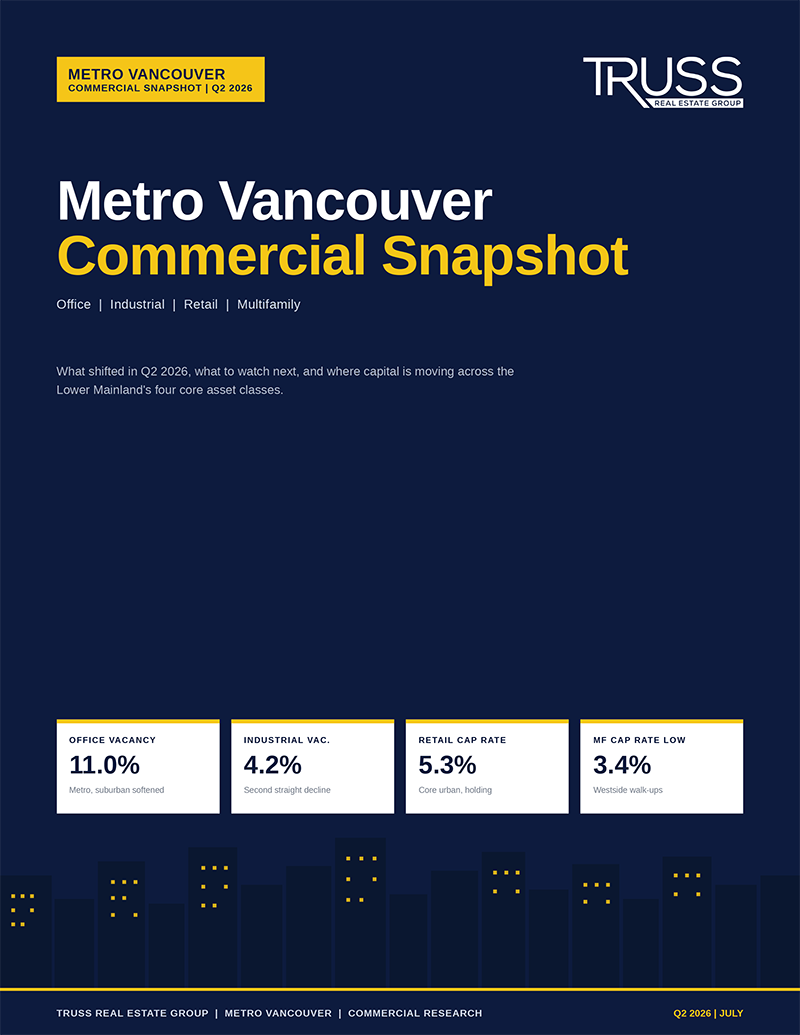
Click to view the report
Capital Becomes Increasingly Selective as Market Recovery Continues
After several years of uncertainty, Metro Vancouver’s commercial real estate market is beginning to show signs of a more sustainable recovery. The second quarter of 2026 reinforced a theme we have been watching closely: capital is becoming increasingly selective.
High-quality assets in desirable locations continue to outperform, while secondary properties face greater scrutiny from tenants and investors alike.
Here is our take on what happened across the region’s four core commercial asset classes, and what we are watching for through the remainder of 2026.
Office: A Market Divided
The office market continued its gradual recovery in Q2, with downtown Vancouver remaining the stronger performer. Class A buildings attracted steady leasing activity, supported by a fourth consecutive quarter of positive national office absorption, while the development pipeline stayed historically limited. In fact, the only office project to break ground in Vancouver during the quarter was the city’s first office construction start since 2024.
The recovery is not perfectly smooth, however. Roughly 156,000 square feet of sublease space returned to the downtown core in Q2, and suburban office markets moved in the other direction, with vacancy rising in several municipalities. The takeaway is consistent across the market: tenants continue to prioritize quality, amenities, and location over simply securing more space.
For investors, the lack of new office construction may prove to be one of the most important long-term trends. Limited future supply should support well-positioned existing assets as demand continues to recover.
Industrial: Fundamentals Continue to Improve
Industrial remains one of Metro Vancouver’s strongest-performing asset classes.
Availability declined for the second consecutive quarter as much of the large-format space that entered the market over the past two years was absorbed. The overhang of big-box space above 100,000 square feet, which had weighed on the market since 2023, was cut roughly in half. At the same time, speculative construction continues to slow, helping restore the balance between supply and demand.
Asking rents appear to be stabilizing after several quarters of moderation, and we expect quality logistics and distribution assets to remain highly sought after through the second half of the year.
Retail: Stability Holds
Retail continues to hold firm.
Neighbourhood retail, grocery-anchored centres, service-oriented retail, and high-street locations remain well occupied, with vacancy generally holding between 2% and 4%.
One of the quarter’s biggest milestones was the May opening of Oakridge Park’s retail district, roughly 650,000 square feet anchored by more than 100 global and local brands. As one of Vancouver’s largest mixed-use developments, it is expected to reshape retail spending patterns while reinforcing demand for premium retail locations across the city.
Private investors also continue to show strong interest in stabilized retail assets that offer dependable cash flow.
Multifamily: Strong Investment Demand Meets Rising Supply
Multifamily remains one of Canada’s most attractive investment sectors, but the market is evolving.
While apartment cap rates remain compressed for well-located assets, the significant wave of purpose-built rental completions over the past two years has increased vacancy and softened asking rents in several submarkets.
For investors, underwriting has shifted. Rather than relying on aggressive rent-growth assumptions, buyers are increasingly focused on stable income, replacement cost, financing opportunities, and long-term fundamentals.
What We’re Watching
As we move through the second half of 2026, several trends will likely shape investment activity:
- Whether suburban office markets begin to stabilize.
- Continued tightening within Metro Vancouver’s industrial market.
- The long-term impact of Oakridge Park on surrounding retail corridors.
- How the recent increase in rental supply affects multifamily pricing.
- Interest-rate decisions and trade policy, which will continue to influence investment confidence.
The Truss Perspective
While transaction volume remains below historical peaks, buyer activity has become noticeably more focused. Well-located industrial properties, stabilized retail investments, quality multifamily assets, and owner-user opportunities continue to generate strong interest when priced appropriately.
Today’s market rewards preparation and realistic expectations. Sellers who understand current conditions are attracting qualified buyers, while investors concentrate capital on assets with durable cash flow and long-term value.
The recovery is underway, but success increasingly belongs to the highest-quality opportunities.
Work With Truss Real Estate Group
If you are considering buying, selling, leasing, or investing in commercial real estate across Metro Vancouver, our team is here to help you navigate the market with data-driven advice and local expertise.
Connect with us to discuss your commercial real estate goals.
Truss Real Estate Group | Stonehaus Realty Corp.
Commercial. Development. Investment.